
As a homeowner in Massachusetts—especially in historic, coastal towns like Amesbury and Newburyport—finding out you have uninvited wildlife living in your home is never a pleasant experience. While mice and squirrels are common culprits that tend to make a lot of noise, bats are another frequent squatter that often goes completely unnoticed until the colony has grown significantly.
Because bats are nocturnal and typically access the upper, unused portions of your home like attics, eaves, and soffits, they can be remarkably stealthy. They don’t chew wires like rodents, and they don’t tear up insulation to build nests like squirrels. Instead, they simply hang upside down and sleep during the day. However, if you know what to look (and listen) for, you can catch an infestation before it leads to massive structural damage or health risks. Here are the top signs that you might be sharing your Massachusetts home with a bat colony.
1. Strange Noises at Dawn and Dusk
Unlike squirrels, which are active during the day, bats are strictly nocturnal. If you have bats in your attic, you will typically hear activity right around sunset when they are waking up and preparing to leave for their nightly hunt, and again at dawn when they return to roost.
Listen for soft scratching, squeaking, or scuttling noises coming from the ceiling, walls, or chimney. Because bats vocalize at a frequency that is mostly undetectable to human ears (echolocation), you are much more likely to hear the physical sounds of them shifting around, grooming themselves, and crawling against the drywall before taking flight. If you hear frantic scratching right at dusk, it is a very strong indicator of bats.
2. The Presence of Bat Guano (Droppings)
One of the most obvious and dangerous signs of a bat infestation is the accumulation of bat droppings, known as guano. You might find small piles of guano on your porch, window sills, deck, or directly underneath the roofline.
Bat guano looks somewhat similar to mouse droppings—dark, elongated, and about the size of a grain of rice—but it has a distinct difference. Because bats exclusively eat insects, their droppings are full of shiny, undigested insect parts (like wings and exoskeletons). If you shine a flashlight on the droppings, they will often sparkle slightly. Furthermore, if you touch it (which you should only ever do with gloves and a mask due to disease risk), bat guano crumbles easily into dust, whereas mouse droppings tend to be hard and solid.
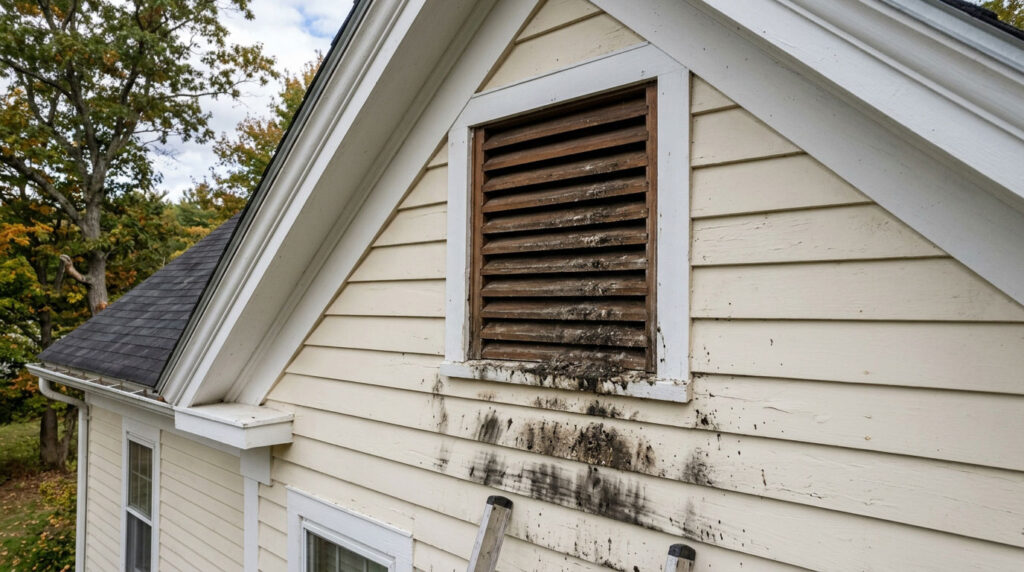
3. Brown or Black Smudge Marks Around Entry Points
Bats have a layer of natural oils and grease on their fur, similar to rodents. When a colony repeatedly uses the same entry and exit points to squeeze into your attic, those oils rub off on your siding, brickwork, or fascia boards.
Look for dark, dirty smudge marks or greasy streaks around small gaps near your roofline, chimney, or attic vents. A bat only needs a gap of 3/8 of an inch to enter a building. If you see a hole the size of a dime with a dark, greasy ring around it on your Amesbury or Newburyport home, it’s highly likely that bats are using it to get inside.
4. Foul, Ammonia-Like Odors
When a bat colony has established a roost in your attic, the accumulation of guano and urine will eventually begin to smell. Bat urine contains high concentrations of uric acid, which emits a strong, pungent odor very similar to ammonia.
If you notice a foul, unexplained smell drifting down into your upstairs bedrooms or hallways—especially on hot, humid summer days in New England—it’s time to inspect the attic. The smell is not just unpleasant; it is a sign of a biohazard that requires professional remediation.
5. Seeing Bats Flying Around Your Home at Dusk
Sometimes the most obvious sign is visual confirmation. If you suspect you have bats, grab a lawn chair and sit outside your house just before dusk. Watch your roofline closely. If you have an infestation, you will likely see bats swooping out of a specific vent, louver, or gap in the siding to go hunt for mosquitoes.
Why You Shouldn’t Ignore a Bat Infestation
Ignoring a bat infestation is never a good idea. A small maternity colony of just a few bats can quickly grow into a massive colony of dozens or hundreds over a few years. The longer they stay, the more guano accumulates, compressing your insulation and introducing the risk of Histoplasmosis—a severe respiratory disease caused by fungal spores in the guano.
Suspect You Have Bats? Call Safer Nature Pest Control!
If you’ve noticed any of these signs, do not try to investigate a confined attic space on your own. Startling a bat can lead to bites, and disturbing guano can send dangerous spores into the air. Contact the wildlife experts at Safer Nature Pest Control. We provide comprehensive, professional inspections in Amesbury, Newburyport, and surrounding areas to properly identify the problem and safely, legally exclude the bats from your home.
Frequently Asked Questions (FAQ)
How do I know if I have bats or mice in my attic?
The main difference is timing and droppings. Mice are active at various times and their droppings are hard. Bats are active specifically at dawn and dusk, and their guano crumbles into dust and sparkles with insect wings.
Can bats chew through wood or wires?
No. Unlike rodents, bats are not chewers. They do not have the teeth or jaw strength to chew through wood, drywall, or electrical wires. They simply squeeze through existing gaps.
Who do I call for bat removal near me in Amesbury?
You should call a licensed wildlife control professional like Safer Nature Pest Control. We specialize in humane, legal bat exclusion services across Essex County.